In today’s competitive digital landscape, simply having a website or social media page is not enough. Businesses need a strategic approach to attract the right audience, generate leads, and convert visitors into customers.
Three of the most powerful digital marketing channels are SEO, Google Ads, and Meta Ads. But which one is right for your business?
The answer depends on your goals, budget, target audience, industry, and how quickly you want to see results.
In this guide, we’ll compare SEO vs Google Ads vs Meta Ads and explain when businesses should use each strategy.
What Is SEO?
Search Engine Optimization (SEO) is the process of improving your website and online presence so that your business can appear higher in organic search results on search engines like Google.
For example, imagine someone searches:
“Best digital marketing agency in Wayanad”
If your website appears among the top organic results, that visibility can bring relevant visitors without paying for every click.
Benefits of SEO
- Builds long-term organic visibility
- Can generate consistent website traffic
- Helps establish authority and trust
- Targets people actively searching for solutions
- Supports local business visibility
- Creates sustainable traffic over time
The limitation of SEO
SEO usually takes time.
You may need several months of consistent work before seeing significant results, especially when targeting competitive keywords.
SEO is therefore best suited for businesses that want to build long-term online visibility and sustainable growth.
What Are Google Ads?
Google Ads is a paid advertising platform that allows businesses to display advertisements across Google’s ecosystem.
One of its biggest advantages is search intent.
For example, someone searching:
“digital marketing strategist in Wayanad, Kerala”
is already looking for a specific service.
A business can use Google Ads to appear prominently when potential customers search for relevant keywords.
Benefits of Google Ads
- Reaches people with high purchase intent
- Can generate traffic quickly
- Allows precise keyword targeting
- Provides measurable campaign data
- Offers control over advertising budgets
- Can generate leads and sales quickly
The limitation of Google Ads
Google Ads requires an advertising budget.
When you stop paying for your campaigns, your paid visibility generally stops as well.
That’s why Google Ads works particularly well when you need immediate visibility, leads, or sales while building your long-term organic presence.
What Are Meta Ads?
Meta Ads are paid advertisements delivered across platforms such as Facebook and Instagram, allowing businesses to reach audiences based on factors such as interests, demographics, behaviors, and interactions.
Unlike Google Search, where users often actively search for something, Meta Ads can introduce your product or service to people while they are browsing social platforms.
For example, a local restaurant could show an attractive food advertisement to people in a specific geographic area who are likely to be interested in dining out.
Benefits of Meta Ads
- Excellent audience targeting
- Strong visual advertising opportunities
- Effective for brand awareness
- Useful for lead generation
- Powerful for retargeting
- Works well for products and visually appealing services
The limitation of Meta Ads
Users on Facebook and Instagram may not be actively looking for your product when they see your advertisement.
Your creative, message, offer, and targeting therefore need to capture attention quickly.
Meta Ads are particularly useful for creating demand, building awareness, generating leads, and retargeting potential customers.
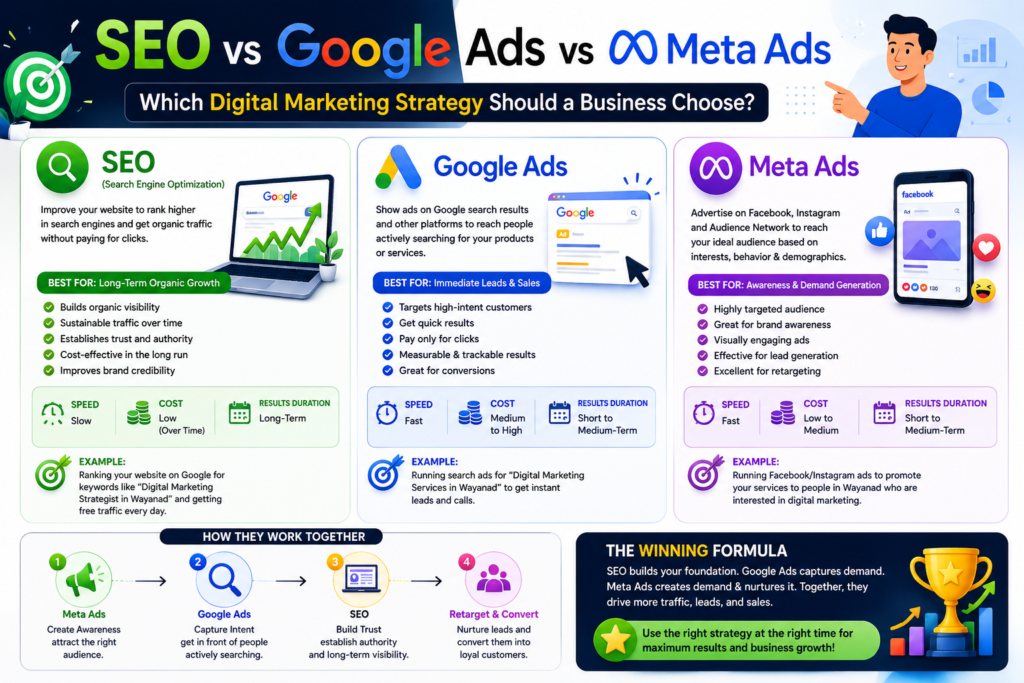
SEO vs Google Ads vs Meta Ads
The biggest difference between these three strategies is how they reach potential customers.
| Strategy | Best For | Speed | Long-Term Value | Main Strength |
|---|---|---|---|---|
| SEO | Organic growth | Slow | High | Search visibility |
| Google Ads | Immediate demand | Fast | Medium | High purchase intent |
| Meta Ads | Awareness & demand generation | Fast | Medium | Audience targeting |
Which Strategy Should Your Business Choose?
There is no universal winner.
The best strategy depends on what your business wants to achieve.
Choose SEO If You Want Long-Term Growth
SEO is a strong choice if your goal is to:
- Build organic traffic
- Increase search visibility
- Establish industry authority
- Generate consistent leads
- Reduce dependency on paid advertising over time
For example, a local service provider could create content around topics such as:
“Best Digital Marketing Strategies for Small Businesses in Kerala”
and optimize it for relevant search queries.
Over time, this content can attract people researching digital marketing services.
Choose Google Ads If You Need Results Quickly
Google Ads can be a strong option when customers are already searching for your product or service.
For example:
“SEO agency near me”
“Google Ads management services”
“Digital marketing strategist in Wayanad”
These searches indicate potential commercial intent.
Instead of waiting for organic rankings, businesses can use paid search advertising to reach those users immediately.
Choose Meta Ads If You Need Awareness and Demand
Meta Ads are especially useful when your audience spends significant time on Facebook or Instagram.
They can be effective for:
- E-commerce brands
- Restaurants
- Real estate businesses
- Fashion brands
- Educational services
- Fitness businesses
- Local businesses
- Personal brands
Strong visuals, compelling offers, and audience targeting can help businesses introduce their products to potential customers.
Why You Shouldn’t Always Choose Just One
One of the biggest mistakes businesses make is treating SEO, Google Ads, and Meta Ads as competing strategies.
They can actually work together.
Think of digital marketing as a customer journey.
Step 1: Meta Ads → Create Awareness
Someone discovers your brand through Facebook or Instagram.
Step 2: Google Search → Build Intent
Later, that person searches for your brand or service on Google.
Step 3: SEO → Build Trust
They discover your website, blog posts, reviews, and useful content.
Step 4: Landing Page → Generate the Lead
The visitor reaches a focused landing page with a clear call to action.
Step 5: Retargeting → Bring Them Back
If they don’t convert immediately, retargeting campaigns can remind them about your business.
This creates a connected digital marketing funnel instead of relying on a single channel.
A Simple Strategy for a Local Business
Let’s imagine you are helping a local business in Wayanad.
Instead of choosing only one marketing channel, you could build a strategy like this:
SEO
Create optimized service pages and helpful local content.
↓
Google Business Profile
Improve local search visibility and encourage customer reviews.
↓
Google Ads
Target high-intent searches from people actively looking for the service.
↓
Meta Ads
Promote offers, services, content, and brand awareness on Facebook and Instagram.
↓
Retargeting
Reach people who visited the website but didn’t contact the business.
↓
Conversion Optimization
Improve landing pages, forms, calls to action, and follow-up processes.
The result is a marketing system where each channel supports the others.
SEO + Google Ads + Meta Ads: The Winning Combination
The most effective digital marketing strategy isn’t necessarily about choosing between SEO, Google Ads, and Meta Ads.
It’s about understanding when and how to use each channel.
SEO builds your foundation.
It helps your business earn organic visibility and authority.
Google Ads captures existing demand.
It puts your business in front of people who are actively searching.
Meta Ads creates and nurtures demand.
It helps you reach potential customers based on audience characteristics, interests, and behavior.
Together, they can create a powerful full-funnel marketing strategy.
Final Thoughts
So, SEO vs Google Ads vs Meta Ads — which should a business choose?
The answer depends on your business goals.
If you want long-term organic growth, prioritize SEO.
If you need immediate visibility and high-intent traffic, consider Google Ads.
If you want brand awareness, audience targeting, lead generation, and retargeting, Meta Ads can be highly valuable.
But for many businesses, the strongest approach is not choosing just one.
It’s creating an integrated strategy where SEO, Google Ads, and Meta Ads work together to attract, engage, convert, and retain customers.
The real question isn’t:
“Which digital marketing channel is the best?”
It’s:
“Which combination of channels will help my business reach the right customers at the right stage of their buying journey?”
That is where a strategic digital marketing approach makes the difference.